Showing posts with label lefebvre. Show all posts

28 May 2014

the evolution of the dodger second baseman, part 2

when we last saw the dodger second baseman, he (paul popovich) was on his way to the expansion montreal expos, so someone needed to step up in 1969.  that someone was…

ted sizemore (1969-1970)
sizemore (seen with his topps rookie team trophy on his 1970 topps card) actually started the season at shortstop (jim lefebvre was at second), but he moved to second when lefebvre got hurt in mid april.  even though he returned to short when lefebvre came back, walt alston eventually switched sizemore back to second when the club reacquired maury wills to play shortstop.  sizemore played 118 of his 159 games in 1969 as the dodgers' second baseman, and hit .271 as he was named the national league's rookie of the year.  in 1970, he appeared in only 96 games, but made 81 starts at second for the dodgers so he retains his title as their primary second baseman.  he hit .306 that year and was dealt following the season to the cardinals in the dick (rich) allen trade.

jim lefebvre (1971)
look who's back.  lefebvre, who had been the team's primary second baseman in 1965 and 1966 and is a former rookie of the year himself, was back at the position in 1971.  that's lefebvre's 1972 o-pee-chee card, by the way.  he played in 102 games as the dodger second baseman in '71 (98 starts) and hit .245 with 12 homers.

lee lacy (1972)
once again, lefebvre began the season as the team's second baseman, but hit a rough patch in early may and gave way to bobby valentine.  soon thereafter, lee lacy (shown on his 1973 o-pee-chee card) was called up from the minors, and he went on to lay claim to the position.  lacy made 58 starts at second - about a dozen more than valentine and 20 or so more than lefebvre.  he hit .259 and scored 34 runs, but didn't play much in september, as the dodgers called up another guy to play some second.

dave lopes (1973-1981)
lopes (shown on a very crooked 1979 kellogg's card) made 11 starts during the last month of the 1972 season, and i guess alston saw enough.  he handed the position over to lopes in 1973, giving him 133 starts that year.  he dabbled in the outfield from time to time, but otherwise held the position through the 1981 world series.  along the way, he led the league in steals twice, won a gold glove, made four all-star teams, and helped the dodgers to four pennants and a world series title.  he was the second baseman on the team of my youth.

steve sax (1982-1988)
like lopes, sax held the dodgers' second base position until they won a world series title.  lopes, however, was traded prior to the 1982 season while saxy left after the 1988 campaign as a free agent.  before that happened, he was the fourth dodger second baseman to win the rookie of the year award, and he made three all-star teams, including the 1983 squad as alluded to on the 1984 topps glossy all-star card above.  in 1986, sax finished second to tim raines in the batting title race, hitting a career high .332 (raines hit .334).  he twice led the national league in errors while with the dodgers and much was made about his difficulties throwing to first base, but he was still my favorite dodger after steve garvey left town.  besides, i don't think of him defensively - my lasting steve sax memory is of him hitting the first pitch of the 1988 season into the left field bleachers at dodger stadium.

willie randolph (1989)
the yankees and dodgers essentially traded second baseman for the 1989 season, although both signed with their new teams as free agents.  with sax gone to the bronx, the dodgers signed willie randolph (seen on a 1989 fleer update card).  randolph appeared in 145 games in 1989, including 139 starts at second.  he hit .282 and was selected to the all-star team.  however, the dodgers traded him to the a's early in the 1990 season for stan javier.

juan samuel (1990-1991)
following the 1989 season, the dodgers traded mike marshall and alejandro pena to the mets for samuel.  they moved him back to his original position of second base (the mets were using him as their center fielder), and he made 101 starts there for the dodgers in 1990.  the following year, samuel started 150 games at second for the blue, and didn't sniff the outfield.  he made the all-star team that year as well, hitting .271 with 74 runs scored and 23 steals.  samuel began the 1992 season as the team's second baseman, but was released in july.  eric young was called up to take his roster spot, but there was another player who actually played second more than anyone else that year.

lenny harris (1992)
yes, i am using cards from 1992 fleer ultra for both samuel and harris in this post.  it's what i had handy.  deal with it.  the second baseman position in 1992 looked something like this:  samuel, 29 starts; mike sharperson, 33 starts; eric young, 35 starts; harris, 65 starts.  harris had been the team's primary third baseman in 1991, and he played some third as well as short and outfield in 1992 as well.  overall, harris hit .271 while fielding at a clip below league average for second basemen.  many thought that young would be the dodgers' second baseman of the future, but they weren't convinced as he was left unprotected in the 1993 expansion draft and was taken by colorado.  as a result, the dodgers worked out a deal with the rockies to acquire one of their later draft picks to fill the hole at second.  that set into motion events that would lead to one of the worst (thanks to hindsight) trades in dodger history.  stay tuned...

20 May 2014

yeah, their backs are all yellow

continuing on from this morning's post, here are the rest of my 1971 o-pee-chee dodger cards.  they are easy to spot because the reverse side is all yellow...

maury wills
the 1962 nl mvp was in his second run with the dodgers in 1971
but he was definitely slowing down, as he stole only 15 bases in 1971

dodgers team card
the only year they took the team photo in the pavilion seats, as far as i know.
not too many updates to the franchise record holders other than the pennant winners list.  mike marshall's 106 games would be on there instead of bob miller's 74, and shawn green's 49 home runs eclipses duke snider's 43.  interesting that willie keeler was thought to have had 179 singles in 1900, as baseball reference credits him with 175.  even stranger is that he had 190 in 1899, but that is nowhere to be seen on the back of the card.

wes parker
parker made a run at johnny frederick's franchise doubles record of 52 in 1970, hitting 47
he also had a career best 111 rbi in '71

jim lefebvre
again with the black batting gloves
lefebvre replaced jim gilliam as the dodgers' first base coach late in the 1978 season after gilliam suffered what turned out to be a fatal brain hemhorrage.

jerry stephenson
stephenson was a member of the 1967 red sox and pitched for them in the world series that year against the cardinals
after retiring as a player, he spent almost 40 years as a scout for the dodgers and red sox.

willie crawford
with two black batting gloves!
this is the last of the 'sunburst' backs for the dodgers.

this is where the bill buckner card would be if i owned a copy.  it's listed on my nefarious 9 - help a blogger out!  you will be rewarded big time for this card.

jim brewer
brewer pitched in three world series games - one each in 1965, 1966, and 1974.  he struck out harmon killebrew in his 1965 appearance.
not only do the cards from these last series lack the sunburst photos, but we get no french text either.  at least the backs are still yellow!

walt alston
i found alston's card on ebay from a seller who labeled it as a topps card.  luckily they included an image of the back to let me know that it was the o-pee-chee version
it's a bit banged up, but i'll take it for only a couple of bucks as opposed to twenty or so.

willie davis
3 dog chokes up a bit on his bat
davis made the all-star team for the first time in 1971, and also won his first gold glove that year.

tom haller
1971 was haller's last season with the dodgers.  with duke sims, bill sudakis, and some kid named joe ferguson with the club, haller was expendable.
that's a haller back, yo.

rich allen
a fantastic dodger stadium shot with dead grass and the knee of the photographer.
allen was traded to the white sox after just one season with the dodgers for tommy john, and he went on to win the american league mvp in 1972.  the dodgers did ok with john, too.

jose pena
this card has some circular scuffs, but i don't need to spend a ton of money for an upgrade.
pena was effective in his first 12 outings of 1970 as the text notes, but in his other 23 outings that year, he gave up 26 earned runs.

tom paciorek
i thought for sure that this card would be the last one i would acquire, thanks to the rookie presence of  johnnie b. baker and don baylor.  paciorek was included in the trade that brought dusty to los angeles, much to my excitement.
there were just over 100 minor league home runs at the time between the three of them, but they combined to hit more than 650 big league home runs.  that's a powerful card.

i'll keep an eye out for the billy buckner rookie, but i will also turn my attention to the 1972 o-pee-chee dodgers.  thank goodness the o-pee-chee set from that year tops out at number 525 - no steve garvey, don sutton, hoyt wilhelm, or frank robinson cards to worry about!

06 May 2014

the evolution of the dodger second baseman - beginning with jackie

just two positions left to review in my evolutionary posts.  this one is special to me because i spent most of my playing days at second base, and even though i was a steve garvey fan, i marveled at the dodger lineage at second base.  as a little leaguer, i traced it back from dave lopes to jim lefebvre to jim gilliam to jackie robinson.  i later learned that it wasn't quite that clean, but still.  at some point, it traces back to jackie, which is where i will start.  besides, it gives me a reason to show my 1952 topps jackie robinson card again, now freed from its plastic cage.

jackie robinson (1948-1952)
jackie was named the rookie of the year in 1947 when he was the dodgers' first baseman.  in 1948, brooklyn traded their second baseman, eddie stanky, to boston and gil hodges took over at first with jackie moving to second.  he stayed there for five seasons, winning the mvp award in 1949 and leading the league with a .342 average as well.

jim gilliam (1953-1957)
like jackie, gilliam was named the rookie of the year, but he won the award as the dodgers' second baseman in 1953.  that's his 1954 topps card - i unfortunately don't have a copy of his 1953 topps issue.  although gilliam also played some outfield in 1955 and 1956, he was the team's primary second baseman through 1957.  he finished fifth in the league mvp voting in 1956, when he hit .300 and helped the dodgers return to the world series.

charlie neal (1958-1961)
gilliam moved to the outfield in 1958 as the dodgers moved west, and so charlie neal moved from short to second.  he remained the dodgers' second baseman until he was traded to the mets following the 1961 season.  he made two all-star teams for the dodgers in his tenure as their second baseman, including the 1960 team as noted on his 1960 topps all-star card, and he also won the gold glove at the position in 1959.

jim gilliam (1962-1963)
with neal in new york, jim gilliam returned to the position in 1962, which is the year that the bell brand card shown above was issued.  he finished 6th in the mvp voting in 1963 as the team's second baseman, but once the world series came along, he moved to third base and dick tracewski played second in the dodgers' four game sweep of the yankees.

nate oliver (1964)
oliver was a second year player in 1964 when he hit .243 in 99 games and played more second base than any other dodger.  tracewski and gilliam also spent time at the position that season, but oliver started 97 contests there.  in 1965, however, he played second in only 2 games at the big league level.

jim lefebvre (1965-1966)
another dodger second baseman to win the rookie of the year award, lefebvre (shown on his 1965 topps rookie card) hit .250 with 12 homers en route to the honor.  he did better in 1966, hitting 24 homers with a .274 batting average while being named to the all-star team for the only time in his career.  he also began playing some third base, and spent most of the 1967 season at the hot corner.

ron hunt (1967)
hunt was acquired by the dodgers after the 1966 season from the mets in the tommy davis trade.  topps was abel to get him into the 1967 set as seen above, although the card is a bit of a high number (525).  he spent the 1967 season in los angeles before being traded to the giants prior to the 1968 campaign.  during his stint with the dodgers, hunt started 89 games at second base batting .263 while hitting 3 homers and driving in 33 runs.

paul popovich (1968)
with hunt going to the giants, the dodgers turned to popovich, an offseason acquisition from the cubs, to man second base in 1968.  his 1968 topps card there identifies him as an infielder, and he lived up to that billing by playing second, short, and third in '68.  still, his 80 starts at second base is what qualifies him for a spot in the team's evolutionary chain.  he hit only .232 on the season, and was traded to the expos early in the 1969 season, meaning that the merry-go-round of dodger second basemen would continue...

06 April 2014

sunday morning target dodgers

for the second day in a row, i am leading off a post with a card of jim lefebvre! it's lefebvrepalooza time, apparently.  yes, jim lefebvre's card was on this week's sheet of 1990 target cards.  let's have a look (at 14 of the 15 from that sheet, anyway).

jim lefebvre
he's turning two!  i actually put this card in my double play binder - i bought a single online so that i could keep the sheets intact.  i think the only other target single i have is steve garvey.  anyway, lefebvre was the 1965 nl rookie of the year and he was also a henchman of the riddler on the batman tv show.  top that justin turner or dee gordon!

hal janvrin
janvrin was on the red sox team (along with babe ruth) that beat the brooklyn robins in the 1916 world series (he hit .217 in the series as the second baseman for the sox).  he joined the robins in 1921 following a midseason trade from the cardinals, and remained with the club through the 1922 season.

roy jarvis
jarvis may well be the shortest tenured of all the dodgers.  as an 18-year old in 1944, he had one solitary plate appearance and struck out (he also caught a few innings that day).  it was his only appearance as a dodger, although he did resurface in the major leagues with pittsburgh in 1946 and 1947.

tim jordan
jordan is the only member of the brooklyn/los angeles franchise to have led the league in home runs more than once - his 12 home runs led the national league in both 1906 and 1908.  jordan spent 4+ seasons with the superbas before his big league career ended in 1910.  he continued to play minor league ball until the age of 41.

frank kellert
kellert spent only one season with the brooklyn dodgers, but it was a good one.  he was acquired via trade from the orioles in march of 1955 in exchange for erv palica, and he went on to appear in the only world series that the brooklyn dodgers won.  kellert hit .325 in 39 games during the regular season, with many of his appearances coming as a pinch hitter.  in the world series, he was 1 for 3 (all appearances were as a pinch hitter) although each game he appeared in were games the dodgers lost.  after the series, kellert was claimed on waivers by the cubs which was unfortunate because topps then had time to put him in a cubs hat on his 1956 topps card.  kellert did get a dodger card in the 1995 topps brooklyn dodger archives set, though.

clyde king
this card would have been killer in color - it would be great in the 1957 topps set.  anyway, king is a dodger double dipper and a former yankee gm.

tony lazzeri
speaking of yankees, lazzeri is best known as the second baseman for the yankees (including the 1927 club), as he spent 12 seasons in new york and won 6 world series between 1926 and 1937.  lazzeri joined the cubs in 1938 and took them to the world series, where they lost to the cubs thanks to a called shot and a billy goat, supposedly.  in 1939, he returned to the east coast as a member of the brooklyn dodgers.  he hit .282 in 14 games for the dodgers and was released.

bill marriot
marriot played for the robins in 1926 and 1927.  he was the team's primary third baseman in 1926, hitting .267 in 109 games.

len matuszek
a modern era dodger!  matuszek came to the dodgers in 1985 in the al oliver trade with toronto.  he stuck with the team as a pinch hitter through the 1987 season, and was 1 for 1 in the 1985 nlcs.

fred mitchell
mitchell's contract was purchased by the superbas during the 1904 season.  he made 8 starts for them that year, and had a record of 2-5.  he returned for the 1905 season, and was 2-7 in 12 pitching appearances, although he also played in the field in more than a dozen other games.  he spent the next few seasons in the minors, but returned to the major leagues in 1910 with the new york highlanders (yankees) as catcher.  mitchell later turned to managing and led the 1918 chicago cubs to the world series in that role.

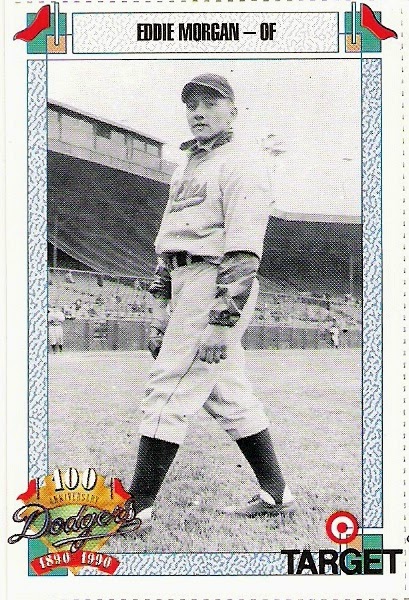
eddie morgan
morgan hit .188 in 31 games for the 1937 brooklyn dodgers following a cup of coffee with the 1936 saint louis cardinals.  morgan has the distinction of being one of the few players to hit a home run in his first major league at bat, and it was the only home run of his career.

val picinich
valentine here was a catcher who joined the robins in 1929 and stayed with the franchise until he was released during the 1933 season.  he appeared in a total of 187 games during that span, and hit .255 with 6 homers.

bill schardt
schardt's major league career consists of 46 games spread over the 1911 and 1912 seasons, all as a dodger.  he posted a record of 5-16 in those appearances and completed 10 of 22 starts.

nick tremark
tremark also spent his entire big league career with the dodgers.  he played in 35 games over the course of three seasons - 1934 through 1936.  he hit .247 and at 5'-5", he was the freddie patek of his day.

thanks as always to baseball reference for shedding light on these guys.  it makes the set much more enjoyable the more you know about the players.